
When starting as an off-roading enthusiast in UAE, it will be essential to learn how to deflate your tires when driving in the sand or trails.


The main reason for deflating your tires is to obtain a longer footprint in the sand, and that enables you to drive on the sand, instead of digging into it. For mountains and wadis it greatly improves the traction in this terrain.
Tyre pressure can be defined in Psi (pounds per square inch) or Bar. You will find both readings on your pressure gauge. In UAE most people use Psi, and the gas station compressors also use the PSI identification.
If you are new to off-roading in the sand, feel free to use our calculator to get a good idea of your optimal tire pressure:
UAE Desert Tire Pressure Calculator – Sandscope
A few helpful tips:
- Theoretically spoken, for driving in the sand, the lower the tire pressure the better, but there are certain limitations: the lateral forces when driving and steering and the weight of your 4×4 can push the tire off the rim. While this can be fixed, it’s of course to be avoided. Respect and maintain a safe tire pressure and monitor it during your trip.
- There are different ways of deflating your tires, and each have their advantages and disadvantages. The more you will practice, the sooner you will find out what works best for you.
- Take note that tire pressure will rise together with the temperature inside the tire, so whenever you take a break, don’t forget to double check your tire pressure and bring them back to your preferred setting.
- In challenging terrains you can deflate a bit more once you have some experience and even experiment with different pressure settings in the front vs rear tires. (the rear tires can usually be allowed to go a little bit lower as you are not using them for steering).
How does a stem valve looks like?

The stem valve is consisting out of 3 pieces. The body, that is made of flexible rubber, the valve core, and the valve cap. On some vehicles that have a TPMS (Tire pressure monitoring system) the valve body will be made of metal.
Take note of the following:
The rubber valve body wears out over time. Once you start to see cracks, it is advisable to get it replaced at the nearest tire center.
The valve core is a tiny component with a small rubber gasket. If you remove it on a regularly, the gasket slowly wears out, or the core can even break. Carry some spares in your vehicle.
The valve cap keeps dirt and sand from entering into the valve, so it’s advisable to always screw the cap back on.
The process of deflating / inflating goes by either pushing in the valve core, which allows air to be released, or by removing the valve core, which is a much faster option.
If deflation time worries you, there are professional tools available to speed up the process significantly:
RCV – RAPID CONNECT VALVE – Apex Performance Products
Rapid Precision Valve [STD] – Apex Performance Products
How do i check the tire pressure?
Verifying your tyre pressure is really easy. Get yourself a pressure gauge, and push it against the tyre valve, or screw it on (depending on the model). You will see the reading in Psi or Bar.

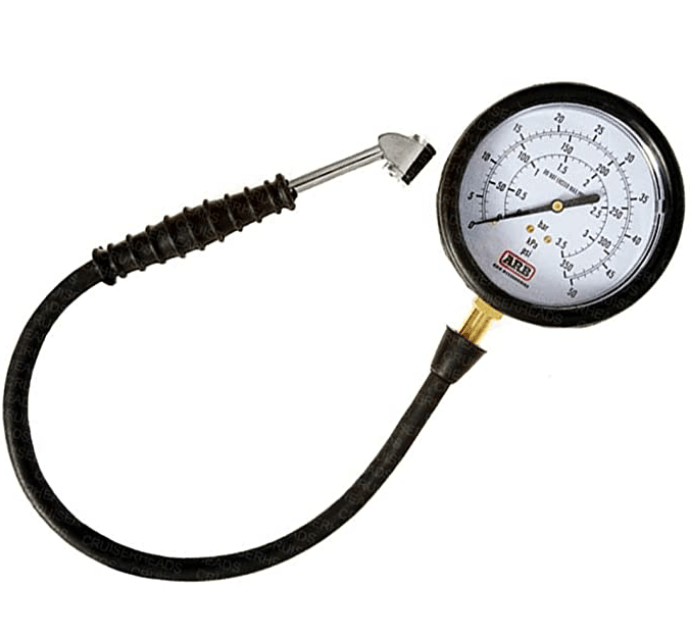
The digital ones are fine, but one day the battery will be empty, so a good old analogue is preferred to have as well as a backup.
Take note that almost every pressure gauge will have a 1-2 psi error, especially on very low pressures.
On vehicles equipped with TPMS, you will often be able to read out each individual wheel its pressure via your dashboard menu.
How to deflate the tires
There are several tools that you can use to drop the tire pressure in your tires, but by far the easiest tool is the valve core removal tool:

This tool can be used to screw out and remove the valve core (see pic above). Just be careful not to lose it. Some valve core removal tools have a magnetic head, which helps to keep the valve core attached so it doesn’t fly away.
Depending on the type of valve, the tire pressure will drop quickly, and while doing this you can push your pressure gauge against the core to measure while you are deflating. Just before you reach your desired pressure setting, quickly screw in the valve core again. Soon you’ll get the hang of this, you will be able to deflate all tires in less than two minutes.
ARB Rapid Tyre deflator
https://amzn.eu/d/0aeI1CRn

This tool enables you to loosen the stem, quickly deflate and immediately take a pressure reading.
PROS: Pressure gauge and deflator in one tool.
CONS: Might take a bit of practice to get the hang of it. The knockoff models are very unreliable.
Leave a Reply